

Categories
Buyer Guides, Local Development NewsPublished September 28, 2026
27% Opposed Data Centers in This Virginia Survey. Here’s the Context.

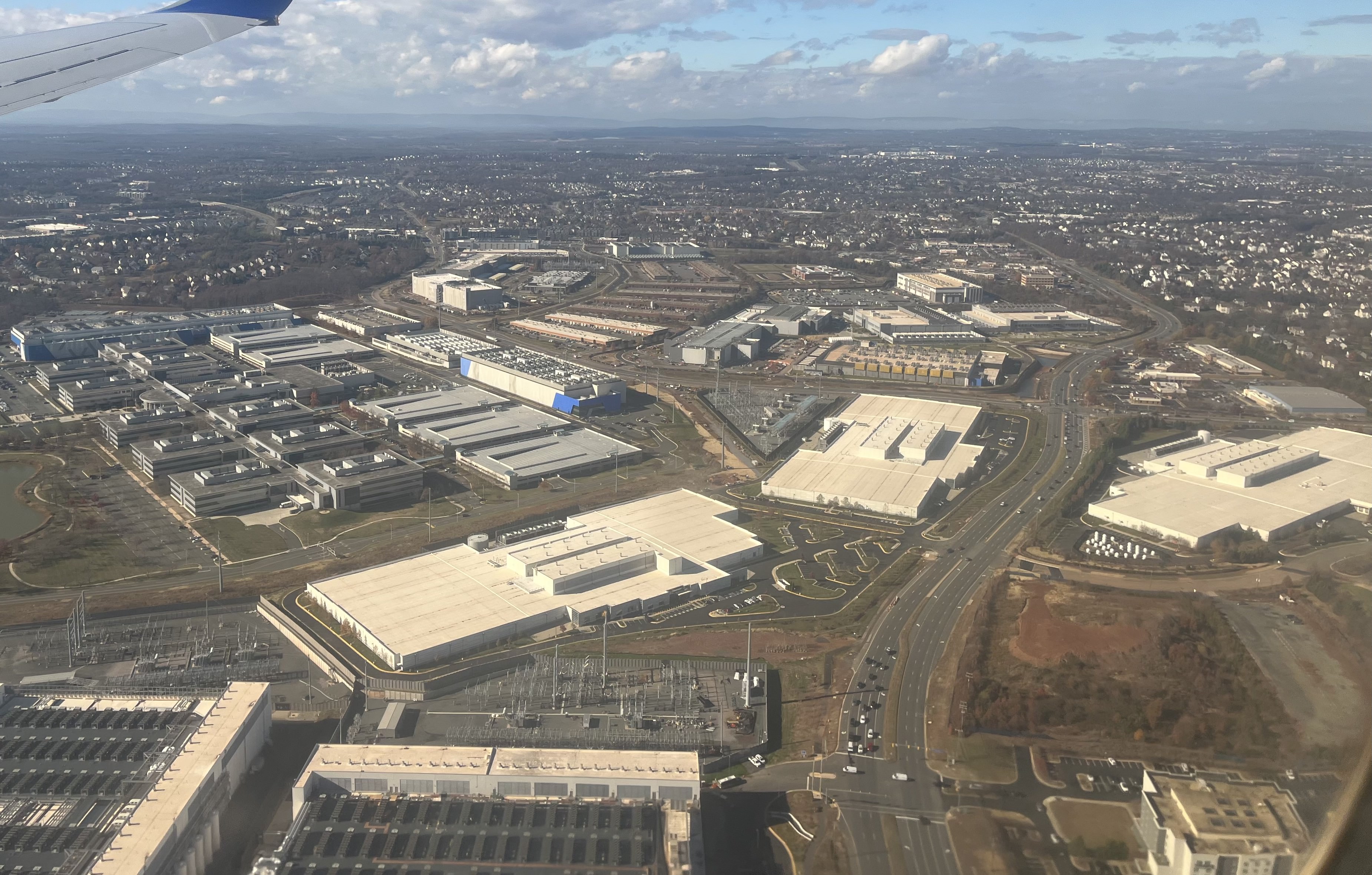
Data centers and other commercial buildings near Ashburn, Virginia, photographed in November 2025. Photo: Theodore Christopher / Wikimedia Commons, CC0.
The number getting attention: About 27% of respondents opposed data center development in their area, compared with 47% who supported it and 25% who were neutral, according to researchers Fengxiu Zhang of George Mason University and Saba Siddiki of Syracuse University. Read their explanation of the findings.
The context belongs next to the headline: This was a survey of 1,004 residents of Northern Virginia and the Richmond metropolitan area, conducted September 3–October 17, 2025. It is a historical snapshot of those respondents—not a current statewide poll. The full study was published in Social Science Quarterly on September 3, 2026.
Stay in the know across Northern Virginia.
Get local news, new openings and community updates from Chris Colgan’s Real NoVA newsletter.
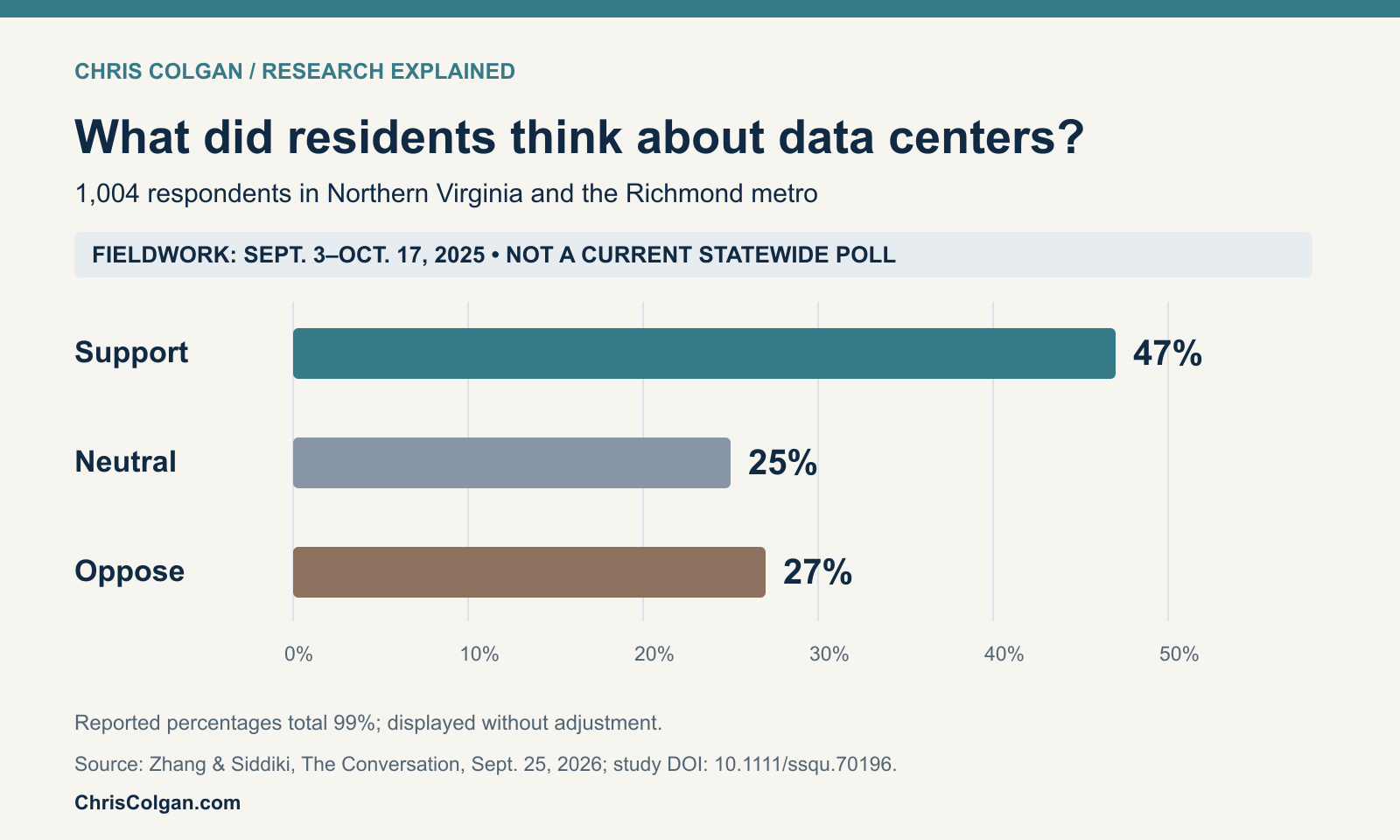
Percentages are reproduced as reported and total 99%. They are not adjusted to force a 100% total.
What residents wanted from the rules
The policy findings give the story more substance than a simple pro-versus-anti argument. Respondents favored:
- Putting new transmission lines underground near homes.
- Community input before project approval.
- Restrictions on locating data centers near sensitive places such as homes and parks.
- Regular disclosure of energy and water consumption.
Electricity-rate choices were less decisive. The authors describe respondents as ambivalent about charging data centers more than other customers. That does not establish support for shifting the industry’s costs onto households. Source: the researchers’ account.
How the researchers tested policy preferences
The online survey used a conjoint experiment: each person chose between five pairs of hypothetical policy packages. Researchers varied the rules within each package to estimate which features influenced choices.
That experiment examined policy tradeoffs; the support/neutral/opposition split describes overall attitudes. They answer different questions. The authors also report a younger, more educated sample and demographic imbalances relative to Virginia’s population. Methodology and limitations.
The practical distinction: Someone can support development in general and still object to a particular location, power-line route or approval process. A regional survey cannot tell you what the people living beside one proposed project think.
Why the date matters in Northern Virginia
The survey predates this year’s latest decisions and proposals. But calling it a snapshot from “before the backlash” would go too far: public debate and policy changes were already underway.
For example, Loudoun approved its first phase of data center zoning changes on March 18, 2025, before the survey began. The changes generally moved data centers from by-right approval to a special-exception process, with grandfathering provisions. Loudoun’s project page.
There is also a current distinction worth getting right. As of September 28, 2026, Loudoun’s official update describes a proposed pause on final Board action for certain data center and substation applications. The resolution is scheduled for consideration on October 20. The September action did not itself establish a blanket construction ban. Official update, revised September 24.
We cannot measure how residents’ opinions have changed since the survey without newer, comparable research.
What this means when you are choosing a home
The useful question is what exists—or could be approved—around the specific property you are considering.
Start with the parcel, then work outward:
- Review current zoning and applications. Separate an existing facility, an approved project and a proposal that has not been approved.
- Look beyond the main building. Review available plans for substations, transmission routes, access roads and screening.
- Visit the area yourself. Evaluate the setting at different times and decide what you are comfortable living near. A brief visit does not replace technical noise information.
- Confirm unresolved details with the county. An empty parcel is not a promise that the view will stay the same.
This survey does not establish an effect on home values. We should not use it to promise either a discount or protection from future price changes.
Looking at a home near a proposed development? Send me the property you are considering. My team can help you find the relevant public records, identify questions for the county and compare other locations that fit your priorities.
Advice from Chris: Check before you get attached
In my earlier data center video, my advice was: “Check the county zoning map before you get attached to a house.”
Watch the zoning-research section of my Northern Virginia data center video. It shows the kind of research to discuss with your agent.
The video was published August 1, 2026, before this survey article. It discusses other research and earlier zoning conditions. Use the current county sources above for today’s rules; this post makes no claim about data centers’ effect on sale prices.
Five questions about the data center survey
Does this mean 73% support data centers?
No. Neutral responses cannot be counted as support. The researchers reported the three categories separately.
Does the headline tell me what my neighborhood thinks today?
No. A result across two metro areas cannot stand in for a current survey of a particular neighborhood or county.
Did the study measure home values?
This article concerns residents’ attitudes and policy preferences. Those findings do not establish whether a nearby facility changes an individual home’s value.
Does support for public input mean every project must have a hearing?
No. A preferred policy is different from an adopted rule. Approval requirements depend on the jurisdiction, property and project history. Check the applicable current process.
Can Chris help me evaluate the area around a home?
Yes. We can help you review public planning information, compare locations and identify matters that need an answer from county staff or another qualified professional before you move forward.
Want more Northern Virginia news and local updates?
Join Chris Colgan’s Real NoVA newsletter and get the next edition in your inbox.
Let’s look beyond the listing photos
I’m Chris Colgan, a Northern Virginia native with more than 22 years in real estate. My team helps buyers and sellers connect local market information with the details of a particular property—from nearby development to competing listings and the steps through closing.
If you want an agent who will help you investigate the surroundings as well as tour the house, let’s talk about your move.
Buying in Northern Virginia · Planning to sell · Related: Talk to the neighbors before buying
Chris Colgan | Team Leader
Real Broker LLC | Powered by PLACE
Call/text: 571-437-7575 · Office: 571-621-7660
info@colganteam.com
8427 W Main St, Marshall, VA 20115

Chris Colgan
Team Leader | Chris Colgan Team | REAL | PLACE
or another way