
.jpg)


.jpg)


Categories
Local History, Travel GuidesPublished October 8, 2026
Dulles Airport Was Wild in the 1960s

Before Dulles became part of your vacation logistics, it was a giant experiment in the future of flying. Its original plan sent passengers to planes in enormous lounges on wheels. Its dedication brought together two presidents. Even its three-letter airport code had a plot twist.
Here are seven things about 1960s Dulles that deserve another look. The photos are real archival images. The science-fiction energy is entirely the airport's doing.
Cover photo: Balthazar Korab, Library of Congress, via Wikimedia Commons.

Inside Dulles around 1963: passengers beneath the sweeping terminal ceiling. Photograph by Donald A. Bailey; released by his heirs under CC0, via Wikimedia Commons. Photo source and rights.
1. Your departure lounge could literally drive away
Imagine sitting down at the gate—and then the gate takes you to the airplane.
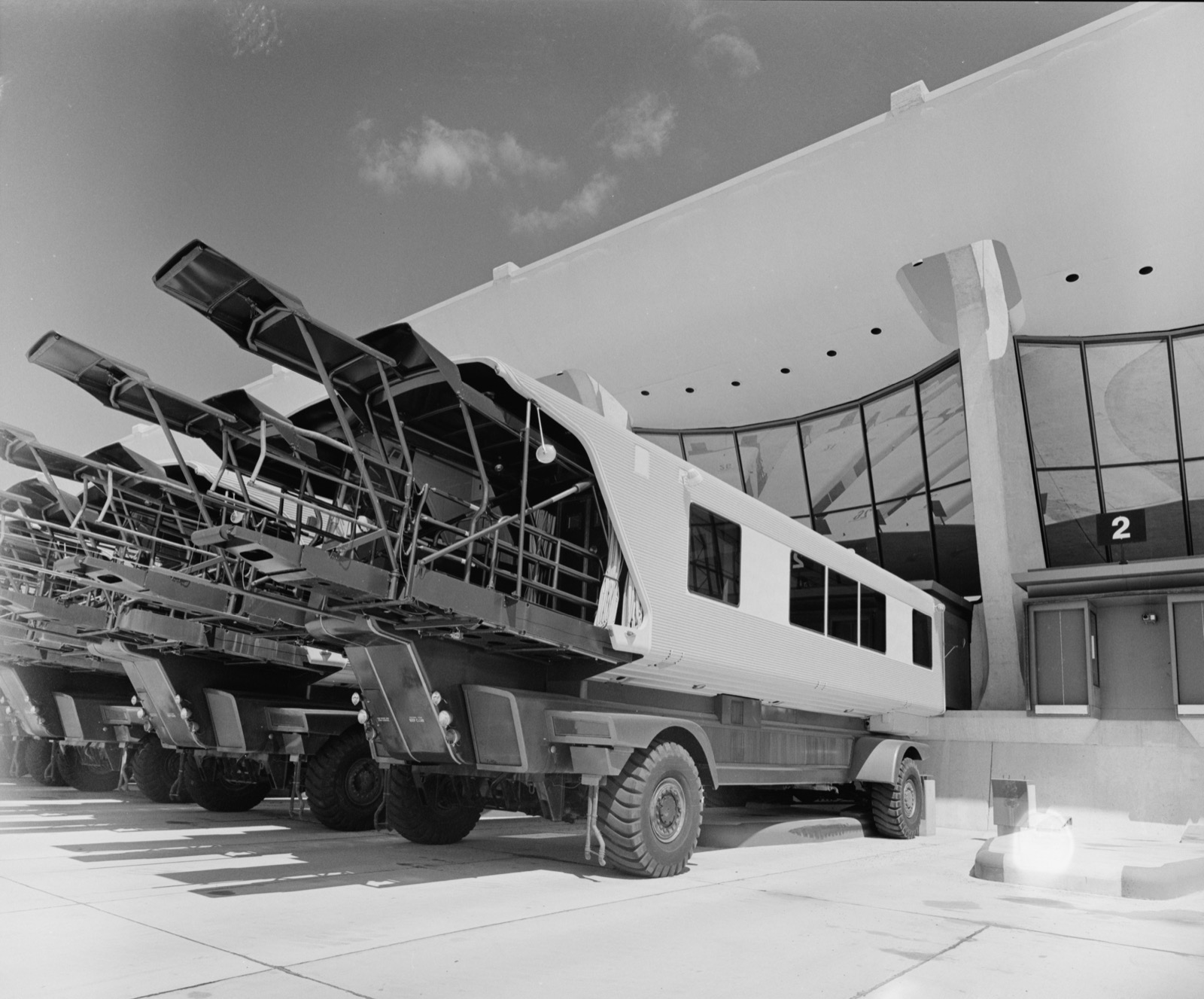
That was the idea behind the original mobile lounges. Passengers boarded at the terminal and rode to aircraft parked on a ramp about half a mile away. Chrysler and the Budd Company developed the vehicles, which could carry 102 people, including 71 seated passengers, according to the airport overview.
The goal was practical: avoid long walks and keep passengers out of the weather and away from jet noise and blast. Dulles' official history explains the system.
A waiting room with a steering wheel. Someone really committed to the concept.

Mobile lounges lined up at the terminal. Photograph by Balthazar Korab, Library of Congress, via Wikimedia Commons. The archive does not supply a precise day for this photograph.

A whole row of waiting rooms on wheels. Early mobile lounges at Dulles; exact photograph date unspecified. Balthazar Korab, Library of Congress, via Wikimedia Commons. Photo source and rights.
2. The terminal looked like the future had already arrived
That sweeping roof was architect Eero Saarinen's work. The original terminal was 600 feet long, with a design that avoided the long boarding fingers extending from conventional terminals. The mobile lounges did that connecting work instead.
The building won an American Institute of Architects First Honor Award in 1966, according to the airport's history.
Look at the construction photograph below. Even the unfinished structure has more personality than most finished buildings.

Dulles under construction. Balthazar Korab, Library of Congress, via Wikimedia Commons. Catalog date range: 1958–1963.
3. Opening festivities had a two-president guest list
President John F. Kennedy dedicated the airport on November 17, 1962. Former President Dwight D. Eisenhower was there, too.
Kennedy called it “a great airport at a great time in the life of our country.” His dedication remarks treated the building as an expression of America's future, pairing that ambition with the importance of preserving its past.
Some openings get a ribbon and a folding table. Dulles got that guest list.
4. It was DIA before it was IAD
This is a particularly good airport-trivia ambush: Dulles originally used DIA.
The identifier changed to IAD on May 22, 1968. An FAA historian's account says confusion with Dallas was sending passengers to the wrong destination.
Missing your exit is one thing. Landing in the wrong part of the country is a much larger itinerary problem.

Before the finished silhouette: curved supports rising from the Dulles construction site. Balthazar Korab, Library of Congress, via Wikimedia Commons; cataloged after 1958. Photo source and rights.
5. This whole story almost happened in Burke
Before the Chantilly site was selected in 1958, the federal government had purchased land in Burke for the airport in 1951. Local opposition helped stop that plan, according to the FAA history.
That is a substantial alternate ending for Northern Virginia's map.
And the eventual airport site was not empty land: the same account records the removal of 580 buildings, including 300 homes. The futuristic design came with a real cost to people already living there.
6. The airport had a pitch film before it had passengers
In 1958, the Eames Office made The Expanding Airport to help Saarinen explain the concept. The film focused on making airports more efficient and reducing the long walks passengers faced while carrying luggage.
You can explore the nine-and-a-half-minute film on the Eames Office's official page.
For the design-history crowd, this is the bonus feature. It lets you approach the airport through the problem its designers were trying to solve: getting people from the front door to the aircraft without an endurance event in between.

The future, in miniature: a Dulles airport model being worked on in a studio. Balthazar Korab, Library of Congress, via Wikimedia Commons; cataloged after 1958. Photo source and rights.
7. The future had a surprisingly quiet start
The FAA account notes that critics called Dulles a “white elephant.” Commercial flights began November 19, 1962, two days after the dedication.
The airport did not reach one million annual passengers until 1966, according to its official history.
It is a useful reminder when looking at those nearly empty archival photographs: a spectacular building and a busy airport are two different achievements.

One more look behind the finished architecture: a curved support during construction. Balthazar Korab, Library of Congress, via Wikimedia Commons. Catalog date range: 1958–1963. Photo source and rights.
The quick answers for your next airport conversation
When did Dulles Airport open?
Its dedication was November 17, 1962; commercial flights began November 19.
Who designed the original Dulles terminal?
Eero Saarinen designed the terminal and original control tower.
Why did Dulles use mobile lounges?
They carried passengers between the terminal and aircraft, reducing walking and exposure to weather and jet operations.
Was Dulles always called IAD?
No. It used DIA before changing to IAD in May 1968.
Who was Dulles named after?
Former Secretary of State John Foster Dulles, as documented in the airport's official history.
More Northern Virginia, beyond the boarding pass
Which surprises you more: the moving departure lounges, the original DIA code, or the airport almost ending up in Burke? Send this to the person who always has an opinion about Dulles.
If you are exploring the area today, start with our guide to living in Leesburg. Planning a move? Talk with my team about buying in Northern Virginia, including how airport access fits into your everyday life.
Sign up for my Northern Virginia breaking-news newsletter.
Researched October 8, 2026. Historical photographs: Balthazar Korab Archive, Library of Congress, via Wikimedia Commons; color terminal interior by Donald A. Bailey, released by his heirs under CC0. Individual source and rights links appear with the photographs. Images are archival photographs, not AI recreations.
Chris Colgan
Chris Colgan
REALTOR® | Team Leader, Chris Colgan Team
Real Broker, LLC | Powered by PLACE
Call or text: 571-437-7575
Office: 571-621-7660
info@colganteam.com
8427 W Main St, Marshall, VA 20115
ColganTeam.com | ChrisColgan.com

Chris Colgan
Team Leader | Chris Colgan Team | REAL | PLACE
or another way